

Architecture and the Absurd

Architecture is inherently about the creation of meaning. While the profession primarily concerns itself with designing buildings, each project is a concretized display of cultural and personal values held by the owner and designers. However, these architectural objects have reciprocal meanings constructed by both the designers and the observers of the building. Writer and philosopher Slavoj Zizek calls this the “parallax view” in architecture: a project is viewed from different perspectives (physically but, more important, personally) that create various meanings for one singular object. This parallax gap underscores the inherent absurdity of architecture.
Absurdism is a philosophy that explores the inherent tension between humanity’s search for meaning and the general indifference of the universe. Albert Camus is a preeminent absurdist philosopher who posits three general responses to the absurd in his book The Myth of Sisyphus:
Escaping life, what Camus broadly defines as “suicide”
A leap of faith, or “philosophical suicide” by imposing meaning through religion
Acceptance of the absurd and rebellion against it
Camus (and I) believe that life can be beautiful without a larger meaning to the universe. To keep living, despite the chaos we experience in life, is inherently an act of rebellion against the absurd. Architecture often reflects these human attempts to impose order and meaning into the chaos of the natural world.
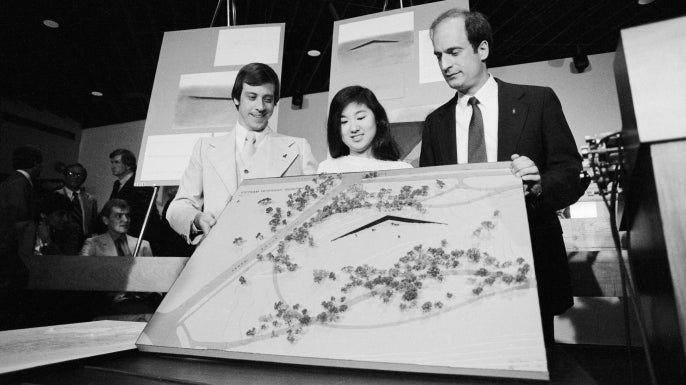
The history behind Maya Lin’s Vietnam War Memorial demonstrates the parallax gap in architecture. The project was initially subject to a wide array of critiques: racists attacked Lin for being a Chinese American woman and critics denounced the work as not being an honorific memorial. Lin’s scheme, which scarred the land with the names of the dead, memorializes the war as a blight on United States history. Tensions were high: the Vietnam war was widely unpopular yet people found the somber memorial to be offensive to the same soldiers shunned on their way to war. Contradiction is commonplace in the architectural progression, but Lin’s project demonstrates the parallax gap that exists when multiple people view the same architectural object from different ideological positions.
Projects from many faith traditions demonstrate the power architecture has to concretize religion. Churches from the Middle Ages in Europe were built out of stone with expert craftsmanship that compelled visitors to see the monuments as creations with divine intervention. Stained glass windows bathed the stone in warm ethereal light and the wall height was determined by how tall the bricks could be stacked up before toppling down. Independent of religious affiliation, it is clear that many religious projects impose a deliberate theological claim, or meaning, in their architecture.
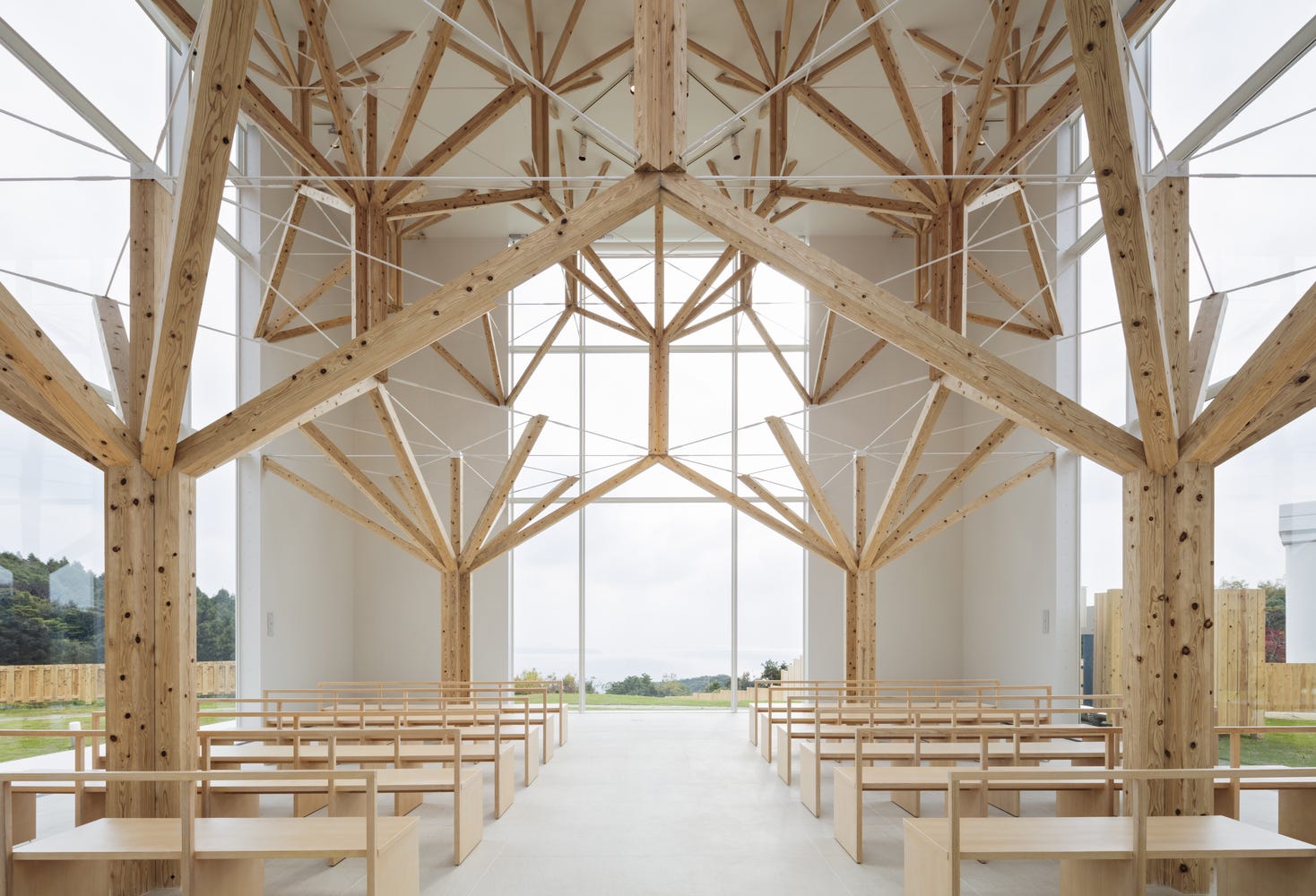
The Agri Chapel by Yousuke Harigane is one of my favorite contemporary religious projects. The modest chapel appears to be a simple white box supported by four tree columns. Do the four trees represent the four disciples of Jesus, does the seemingly simple wood framing combine traditional Japanese assembly with Jesus's history as a carpenter, or does the plan reflect a contemporary twist on the traditional cathedral? Probably, however, it is inherently absurd to assume that these shapes, forms, or layouts have an inherent meaning to them. Part of the magic of church is the imposition of order in an otherwise chaotic universe: the tree columns replicate trees; they do not replace them, and the “logical” floor plan does not reflect a natural logic found in many natural systems on earth. While this project is beautiful it does require a leap of faith to ascribe any actual meaning to the space and form. This chapel does an excellent job of both embracing and challenging traditional forms and meanings inscribed in religious projects,
The rejection of inherent meaning and the acceptance of the absurd will liberate architecture, not destroy it. The two examples above present examples of how meaning is created by both the designer and the user of an architectural object. However, there is no inherent meaning or ascribed to traditional architecture forms. Memorials become memorials when they are used to memorialize things and churches become churches when people pray in them. A particular form can only be as compelling as we (as a society) agree it to be. Parallax views introduce noise into cultural understandings of space with varying individual perspectives that continue reframing and redefining architecture beyond the initial design intent. Moments where conventional materials, forms, and organization are challenged produce more interesting projects while also embracing the absurd world we live in.